Guides
Buying JDM rods: a shipping survival guide
Reels and lures ship cheap. Rods don't. The shipping cost on a long Japanese rod tube can equal a third of the rod's purchase price, and some are simply refused by airlines once they hit a length threshold. Once you understand how the cost cliff works, the right move is obvious: buy a multi-piece rod that packs short. This guide walks through why, what to look for, and which rods in our catalog hit the right spot on price-vs-pack-size.
The shipping cliff
International parcel pricing is dominated by two thresholds, both of which a standard JDM rod tube blows right past:
- Oversized surcharge. EMS, FedEx, and DHL all add a length surcharge once a parcel's longest side exceeds roughly 90 cm. The surcharge scales with length and easily doubles base pricing.
- Air refusal. Above ~150-170 cm (carrier-dependent), most air carriers stop accepting the parcel altogether. The package gets routed to surface mail (sea), which takes 4-8 weeks instead of 5-10 days. Some shops won't even ship rods over a certain length.
A single-piece (1P) rod tube for a 7′ bass rod is about 215 cm. A 10′ surf rod is even longer. Either of those parcels is firmly in the “air refused” tier from most JDM shops.
The math
Rough EMS-to-US pricing for a typical packed rod parcel (1 kg total weight):
| Tube length | Typical EMS to US | What it represents |
|---|---|---|
| ~ 60 cm | $25-35 | 4-5 piece travel rod, packs into a backpack |
| ~ 90 cm | $35-50 | 3-piece rod, fits checked luggage |
| ~ 130 cm | $60-90 | Standard 2-piece bass / light saltwater |
| ~ 170 cm | $110-160 | At-the-limit 1.5P or short 1P |
| 200 cm+ | Sea-only | Standard 1P bass / typical surf rod, 4-8 weeks |
For a ¥40,000 (~$270) flagship rod, that's the difference between a $30 shipping line item and a $130 one. On a ¥10,000 entry rod, the shipping starts to cost more than the rod. The takeaway: shipping cost amortizes much better on higher-value rods, and pack length is the lever you control.
Reading piece codes
JDM rods almost always show piece count in the model name. Common patterns:
- 1P / no suffix: single-piece blank. The longest tube; usually the truest action. Avoid for international shipping.
- 2P: two-piece, butt-joint. Standard for bass rods. Tube ~120-140 cm.
- 1.5P / 2.5P: tip-section split (e.g. the upper third of the blank disconnects). Almost-1P feel, slightly shorter pack.
- -3 / -4 / -5: trailing-number suffix on a model code (e.g. S70ML+-5 = 5-piece). Travel rods. Pack length 50-70 cm.
- T / -T: telescoping (shibairi). Each section nests inside the next. Pack length can be remarkably short.
A useful rule of thumb: anything with a -4 or -5 in the model name is purpose-built to ship cheaply.
Travel-specific series
Each major manufacturer has a travel-rod sub-line. These are designed from the blank up to be multi-piece without sacrificing action:
- Daiwa Black Label Travel · Daiwa Swagger · Daiwa Saltiga J — bass and offshore travel-spec.
- Shimano World Shaula (incl. Technical Edition / MB) · Shimano Capture · Shimano Soare Xtune MB · Shimano Sephia Xtune MB — bass through eging through saltwater.
- Megabass Valkyrie World Expedition · Megabass Levante Travel — tournament bass travel.
- Tiemco Fenwick World Class Expedition — export-tier travel rods (the “J” suffix is JDM spec).
- Tict Minimalist Liberte · Yamaga Blanks Blue Current Wizy · Tailwalk Mobilly — light-game and aji travel pieces from boutique blank makers.
Browse the rods catalog and filter on these brand names if you want to see what's currently in stock at price.
The multi-piece myth
The reflex from older anglers is that multi-piece rods are weaker, less sensitive, or have a “flat spot” at the joint. That was somewhat true in the 1990s, when ferrule technology was crude. It is not true on modern Japanese travel blanks.
Manufacturers test the loaded curve of a 1P version against the 4P / 5P of the same blank and tune the blank schedule to match. A buyer would have to be doing detailed back-to-back casting comparisons in lab conditions to reliably tell them apart. For tournament use Daiwa and Shimano sponsor pros who fish multi-piece rods exclusively in international events.
The practical case for 1P remains specialty rods (e.g. competition jerkbait blanks) where the manufacturer didn't bother making a multi-piece SKU. For everything else: pick travel and don't look back.
Picks from our catalog
Six pack-friendly flagships across the use cases that JDM tackle is famous for. All pack to under 55 cm, all are above ¥30k so the shipping economics work. Pricing reflects current Rakuten listings; click through for live price history.
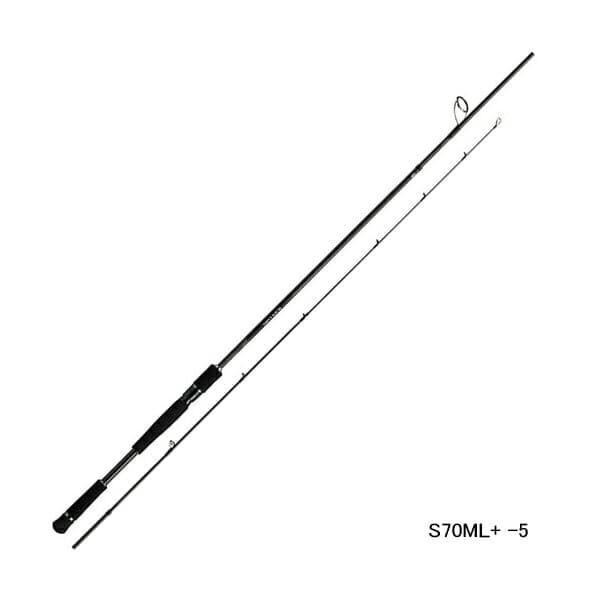
Daiwa Black Label Travel S70ML+-5
5 pieces · 50 cm folded
¥40,238
Daiwa’s flagship bass-spinning travel platform. ML+ power covers spinnerbaits to small swimbaits, 50cm folded fits any carry-on.
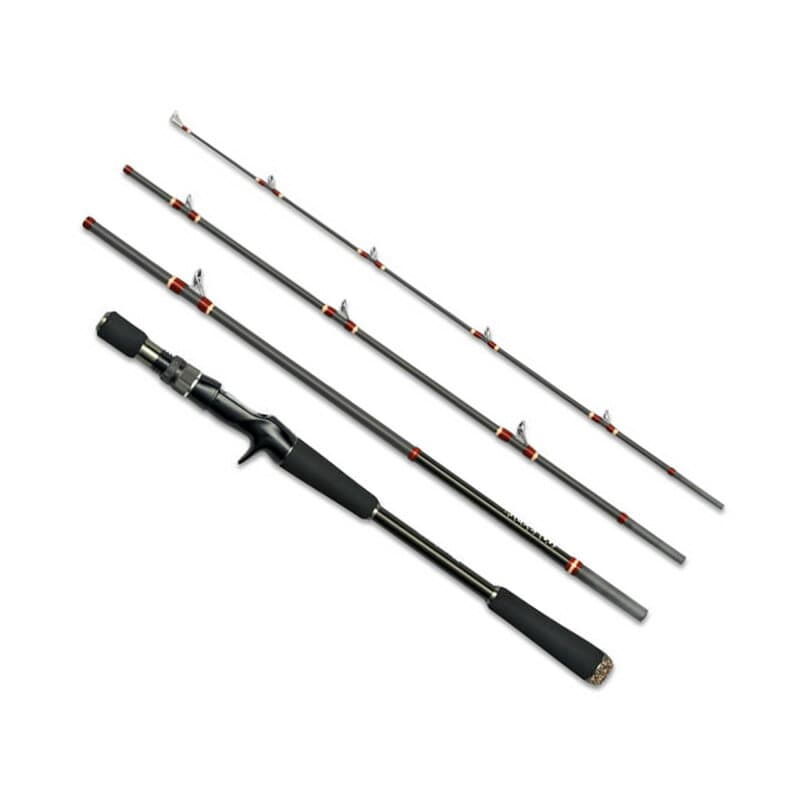
Megabass Valkyrie World Expedition VKC-65MH-4
4 pieces · 54 cm folded
¥34,947
Megabass’s overseas-tournament bass casting blank. MH power, 7-70 g lure rating, packs to 54cm.
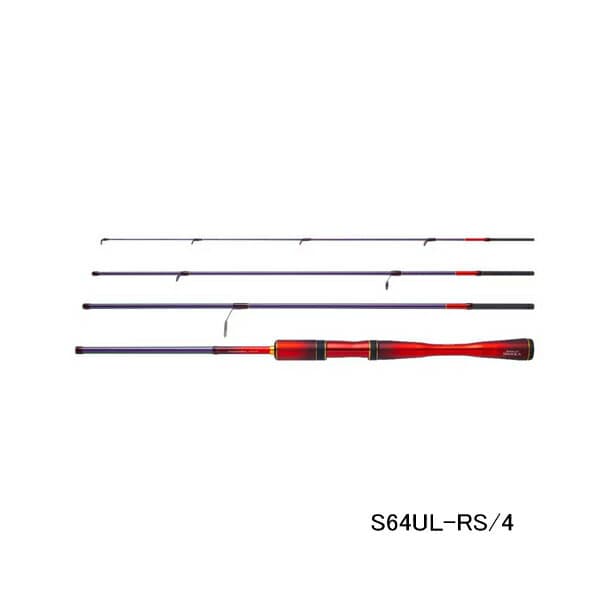
Shimano 24 World Shaula Technical Edition S64UL-RS/4
4 pieces · 53 cm folded
¥48,041
Shimano’s premium UL light-bass spinning. The 4-piece pack fits a backpack, the action is what wins JBT events.
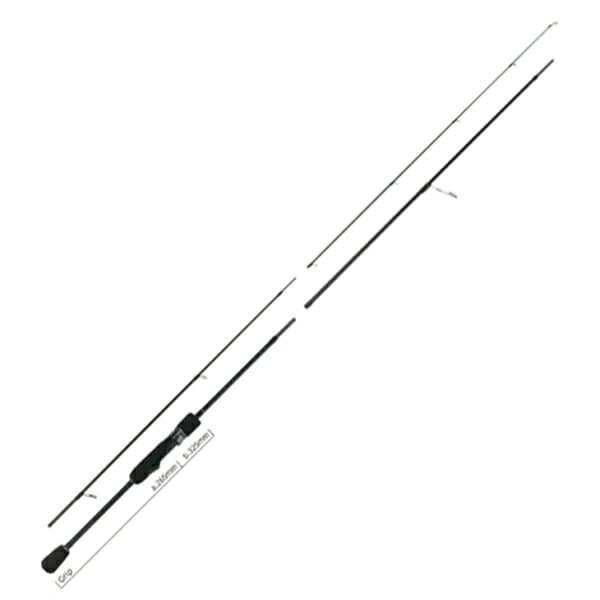
Yamaga Blanks Blue Current Wizy 610/4pcs
4 pieces · 54 cm folded
¥44,500
Yamaga’s travel-spec light-game saltwater. Aji, mebaru, light rockfish, surf skipping. Boutique blank, real travel piece-count.
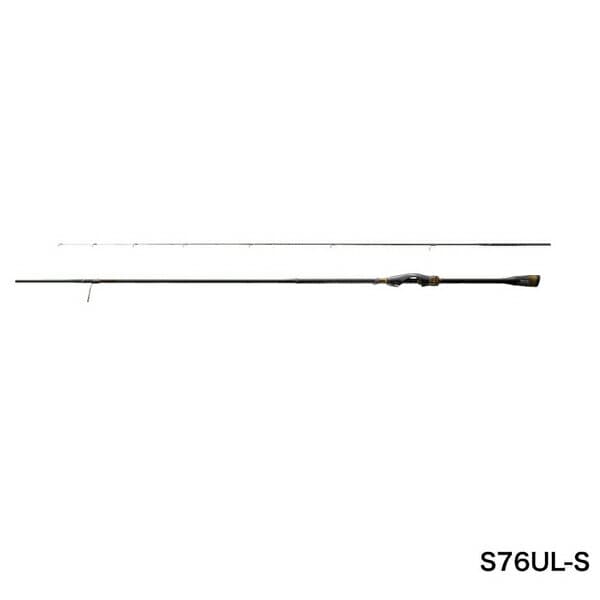
Shimano 21 Soare Xtune MB S76UL-S
5 pieces · 51 cm folded
¥50,616
Soare flagship eging blank tuned for travel. 5 pieces, 51cm folded, fits inside a checked bag with room for tackle.
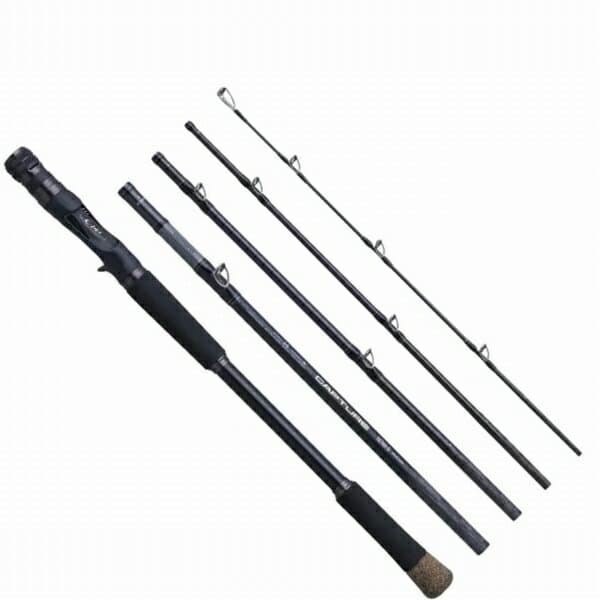
Shimano 25 Capture 167XH-5
5 pieces · 53 cm folded
¥40,480
Heavy big-bait casting platform. Rated to 150 g lures, 5-piece spec, the rare flagship XH that doesn’t require a 7-foot tube.
When to ignore this advice
A handful of cases where eating the shipping cost on a long rod is worth it:
- Specialty 1P that has no multi-piece equivalent. Some flagship Megabass jerkbait rods, niche eging rods, certain ayu rods. If the blank doesn't exist as 4P, 1P is your only option.
- Group buys / consolidation via Zenmarket. If you're ordering several rods at once, Zenmarket can ship them in one tube and the surcharge spreads across multiple items.
- Surface mail is fine for you. Not in a hurry? Sea mail on a 200 cm tube can run $50-70 for a freshwater bass rod, not bad if you can wait 6-8 weeks.
- You're visiting Japan. Pack the 1P in a hard rod tube as checked baggage. JAL and ANA accept rod tubes as oversized at standard luggage rates.
The summary: multi-piece travel rods aren't a compromise; they're the correct answer to the international-shipping problem JDM rod buyers face. Look for -4 or -5 in the model name, browse the rods catalog, and you'll be in good shape.
Related: Reading a Japanese reel model code · How forwarders work
Spot a pick that should be on this list? Drop us a note.